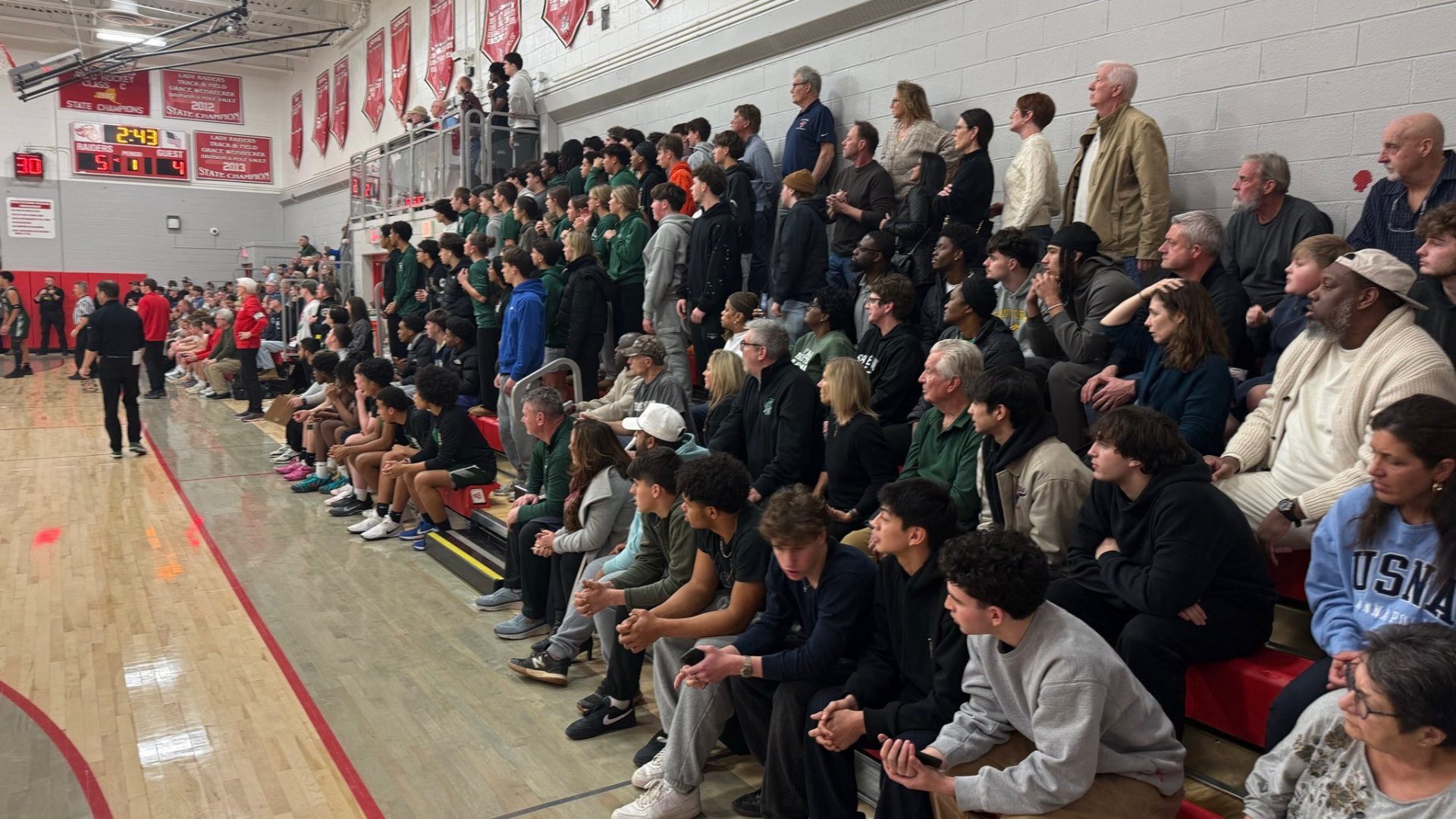
The scoreboard is usually the first thing people notice.
Who won? Who scored? Which team is ranked? Who made the biggest play?
Those questions matter. Competition is part of what makes high school sports exciting.
But the final score has never been the entire story.
Across the Hudson Valley, high school sports remain one of the few institutions capable of bringing an entire community into the same place at the same time.
Students stand together in the bleachers.
Parents arrive straight from work.
Former players return wearing old jackets and faded school colors.
Local businesses hang banners along the fence.
Young children watch from the sideline and imagine the day they will wear the same uniform.
For a few hours, people who may have very little else in common belong to the same team.
That is why high school sports still matter in the 845.
Every Town Has Its Own Identity
The Hudson Valley is not one single sports community.
It is a collection of towns, cities, villages and school districts with their own histories, rivalries and expectations.
Football in Port Jervis feels different from football in Middletown.
Basketball in Kingston carries a different atmosphere than basketball in a smaller school gym.
Programs such as Cornwall, Minisink Valley, Newburgh, Marlboro, Chester, Burke Catholic, Highland and Dover each represent communities with their own traditions.
The uniforms may change, but the connection remains the same.
A school team becomes one of the most visible representations of its town.
When athletes take the field or court, they carry more than their own names. They carry their school, their families, former players and everyone watching from home.
That is why a rivalry game can feel so personal.
The result becomes part of the community’s memory.
Years later, people may forget the exact statistics. They may not remember every possession or every drive.
They remember where they were.
They remember who they watched with.
They remember what the moment felt like.
Sports Give Young People a Place to Belong
For many athletes, joining a team is about more than playing a game.
It can be the first time they feel connected to something larger than themselves.
A team provides structure.
It creates expectations.
Athletes learn that other people depend on them to arrive on time, prepare, communicate and complete difficult work even when they are tired.
They learn how to respond when things do not go their way.
They learn that effort does not always produce an immediate reward.
They learn how to take coaching, how to support teammates and how to remain accountable when nobody is interested in excuses.
Those lessons extend far beyond the season.
Not every high school athlete will play in college.
Very few will become professionals.
That does not make their experience less valuable.
The discipline, confidence, relationships and sense of purpose developed through sports can remain with an athlete for the rest of his or her life.
For some students, the team may also become the strongest support system available to them.
A coach may recognize when something is wrong.
A teammate may provide encouragement during a difficult week.
A program may create stability during a time when life outside of school feels uncertain.
High school sports cannot solve every problem facing young people.
But they can give young people a reason to keep showing up.
The Community Builds the Program
Successful programs are rarely built by athletes and coaches alone.
Behind every team is a larger network of people contributing in ways that may never appear in a box score.
Parents provide transportation, meals, equipment and emotional support.
Booster clubs raise money.
School staff prepare facilities and coordinate events.
Athletic trainers protect athletes.
Officials make competition possible.
Photographers, videographers and local media preserve the moments.
Former players return to mentor the next generation.
Local businesses sponsor programs, purchase advertisements and help teams afford opportunities that school budgets may not fully cover.
The final product seen on Friday night or during a winter championship game is the result of months—and sometimes years—of community investment.
That investment deserves recognition.
When people complain that a local program lacks resources, attendance or visibility, the answer cannot always be that somebody else should fix it.
Strong sports communities are built when everyone contributes something.
That may mean purchasing a ticket.
It may mean volunteering.
It may mean sponsoring a team page or athlete feature.
It may mean attending a game that does not involve a relative.
It may simply mean publicly supporting young athletes instead of only appearing when the team is winning.
Programs become stronger when communities decide they are worth supporting.
Local Businesses Are Part of the Story
High school sports and local business are naturally connected.
The same families sitting in the stands are purchasing food, repairing vehicles, opening bank accounts, visiting doctors, hiring contractors and shopping throughout the community.
Local businesses do not need to treat sports sponsorship as charity.
Done properly, it is a direct investment in local attention and trust.
A business that consistently supports a school program becomes familiar to parents, athletes, coaches and alumni.
Its name becomes attached to something the community already cares about.
That relationship can be more valuable than purchasing an advertisement that people immediately ignore.
But the partnership must be authentic.
Communities recognize when a business is present only for exposure.
The strongest sponsors become part of the season. They celebrate athletes, support events, contribute to coverage and remain visible when the program is not competing for a championship.
That is the type of connection KOT845 wants to help build.
Local sports media can create a bridge between businesses and the communities they serve.
The goal should not be to cover a logo with impressions.
The goal should be to make the business part of the local sports experience.
Coverage Determines What Gets Remembered
Every season produces stories that deserve to last.
A senior plays his final game.
A freshman earns an unexpected role.
A program wins for the first time in years.
A coach reaches a milestone.
A community rallies around an injured athlete.
A team loses a championship but changes the direction of the program.
Without consistent coverage, many of those stories disappear.
The largest schools may receive occasional attention from traditional outlets. Smaller programs and less recognizable athletes are often left with little more than a final score and a few social media posts.
That is not enough.
The Hudson Valley needs coverage that understands the difference between simply reporting a result and documenting a community.
It needs reporting that knows the history behind the rivalry.
It needs platforms that recognize emerging athletes before they become obvious.
It needs team pages, archives, schedules, interviews, rankings and features that preserve the full identity of Section IX sports.
That is part of what KOT845 is being built to provide.
The mission cannot be limited to highlights.
Highlights capture what happened.
Real coverage explains why it mattered.
The Responsibility Belongs to Everyone
It is easy to say local sports are declining.
People point to smaller crowds, changing participation numbers, transfer activity, travel sports and increased competition for attention.
Those concerns are real.
But communities still have the power to determine what their local programs become.
Attend games.
Support student sections.
Promote more than the star players.
Respect officials.
Recognize volunteers.
Support local businesses that invest in athletics.
Teach young athletes that representing their school carries responsibility.
Preserve the history of programs before it disappears.
Most importantly, remember that the athletes competing are still young people.
They will make mistakes.
They will have bad games.
They will miss shots, commit penalties and struggle under pressure.
Coverage and criticism should never lose sight of that reality.
The purpose of local sports is not only to create champions.
It is to help develop people.
More Than a Game
A high school sports season will always produce winners and losers.
Championship banners will be raised.
Records will be broken.
Rankings will be debated.
But the lasting value of sports cannot be measured only in trophies.
It is found in the parent who never misses a game.
The coach who remains after practice to help one athlete improve.
The business owner who sponsors a program because the school once gave him an opportunity.
The former player who returns years later with his own children.
The young athlete standing near the fence, watching the varsity team and imagining the future.
Those moments are the real foundation of high school sports.
They are why Friday nights matter.
They are why packed gyms matter.
They are why local coverage matters.
And they are why high school sports continue to hold communities across the 845 together.
