Who has the best football coaching staff in Section IX?
It sounds like a simple question until the word “best” must be defined.
Is it the staff with the most championships? The staff leading the best team right now? Does developing players matter more than postseason results? How much credit should coaches receive for rebuilding a struggling program compared with maintaining an established powerhouse?
There is no perfect formula.
Still, the results give us several legitimate candidates.
Port Jervis constructed the section’s most dominant recent championship run. Monroe-Woodbury currently controls Class AA. Minisink Valley finally overcame Cornwall to win Class A. Chester has maintained a small-school championship identity across generations. Burke Catholic turned its Class D opportunity into a state-final appearance. Cornwall remains one of Section IX’s most consistent programs, while Saugerties completed one of 2025’s greatest breakthroughs.
Each staff has a different case.
The Criteria
This discussion is based on five areas:
- Championship results
- Sustained success
- Player development
- Adaptability
- Program culture and expectations
Winning one championship matters, but one exceptional roster does not automatically establish the best coaching staff.
The strongest operations develop multiple graduating classes, replace accomplished leaders and remain competitive as personnel changes. They adjust their systems to fit their players instead of relying on one formula forever.
The evaluation must also extend beyond the head coach.
Coordinators, position coaches, junior-varsity coaches and modified-level coaches all contribute to the development of a varsity program. The strongest staffs establish continuity from the youngest level through Friday night.
Port Jervis: The Strongest Complete Résumé
If this debate begins with recent championship production, Port Jervis has the strongest argument.
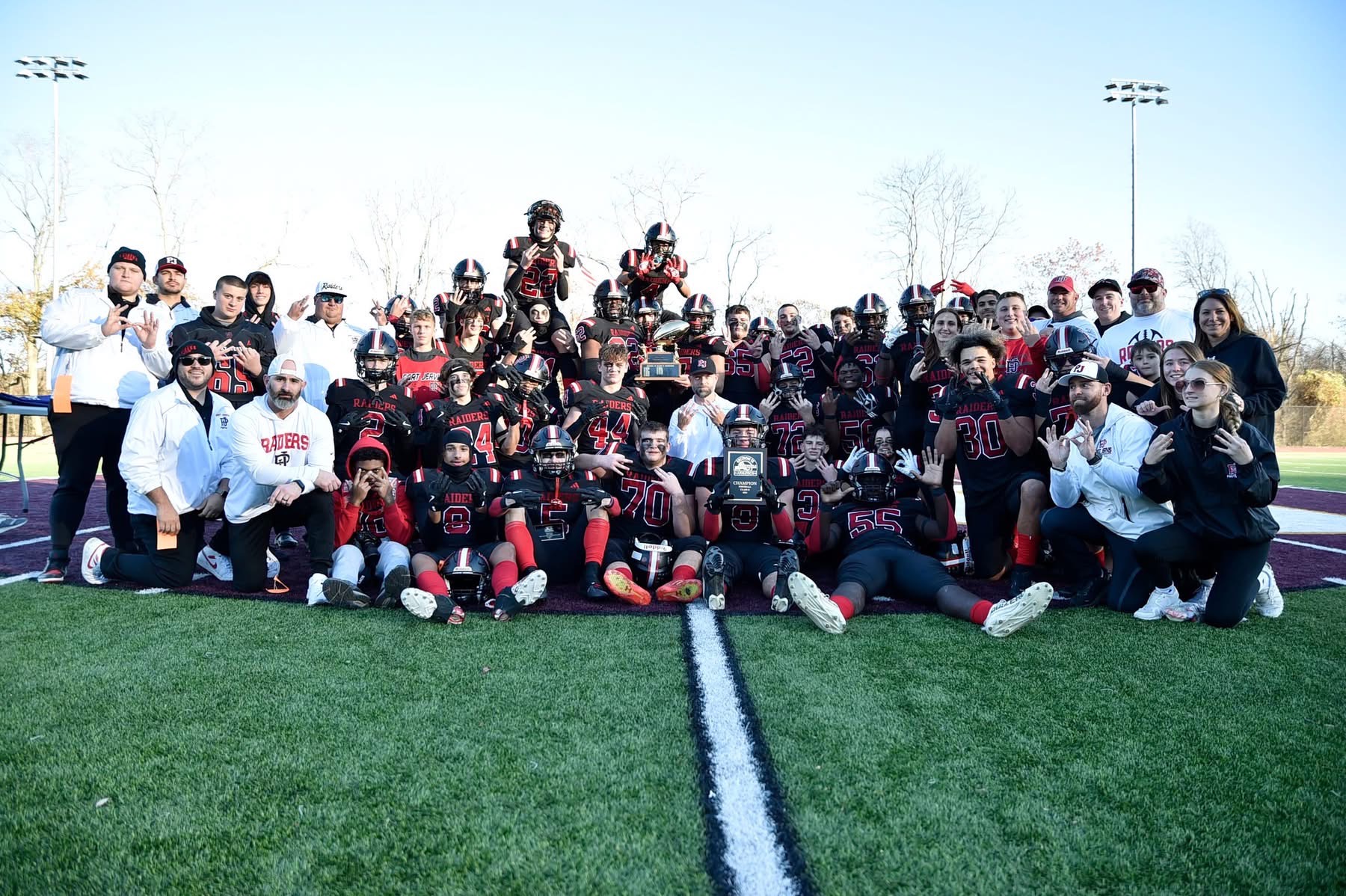
The Raiders won six consecutive Section IX Class B championships across their historic run, which reached its peak when Port Jervis captured the 2024 New York State Class B championship.
Head coach Damien Striharsky was named New York’s Class B Coach of the Year following that season. It was also his fourth Section IX Coach of the Year award.
That success cannot be reduced to one exceptional team.
Port Jervis maintained its standard across multiple graduating classes, different supporting casts and changing postseason challenges. The Raiders repeatedly entered seasons as the team everyone wanted to defeat, yet continued finding ways to finish on top.
The 2024 state championship elevated the argument.
Winning Section IX consistently is difficult. Advancing through the state tournament and finishing the season as New York’s best Class B team requires another level of preparation, execution and belief.
Port Jervis’ sectional championship streak finally ended in 2025 when Saugerties earned a 22–21 victory in the Class B final. Even then, the Raiders finished 9–2 and went undefeated in league play.
One loss does not erase the operation the Port Jervis staff has built.
The next test may reveal even more about it. The Raiders must replace accomplished quarterback Dylan Fox and respond to their first sectional-final loss under Striharsky.
The best staffs do more than build championship teams.
They rebuild them.
Port Jervis now has an opportunity to prove it can do both.
Monroe-Woodbury: The Staff Setting Today’s Standard
Port Jervis owns the strongest recent multiyear resume, but Monroe-Woodbury enters 2026 with the most immediate control over its classification.
The Crusaders have won consecutive Class AA championships, defeating Middletown in the final in both 2024 and 2025.
Those two victories required different performances.
Monroe-Woodbury controlled the 2024 championship game, winning 34–10. The 2025 rematch demanded a response in a much tighter contest, and the Crusaders survived 28–21.
That ability to win in different ways strengthens the staff’s case.
Monroe-Woodbury finished 10–2 last season and went undefeated in league play. The Crusaders also came within one point of advancing past Mamaroneck in the state quarterfinal.
Quarterback Ethan Maldonado provides championship experience, but maintaining the run requires more than experienced play at one position. The staff must continue developing linemen, skill players, defenders and special-teams contributors capable of handling Class AA’s weekly demands.
Middletown has reached three consecutive championship games. Newburgh possesses championship history and significant athletic talent. Every leading Class AA program enters the season with a reason to believe it can win.
Yet all of them are chasing Monroe-Woodbury.
The Crusaders’ staff has moved the program from challenger to two-time defending champion. Completing a three-peat would make its claim to the top position considerably stronger.
Minisink Valley: Port Jervis’ Kryptonite and Class A’s Defending Champion
Minisink Valley’s case is built around persistence, development and finally breaking through in Class A.
Under head coach Kevin Gallagher, the Warriors spent years building toward the moment they reached in 2025. They finished 10–1, went undefeated in league play and defeated Cornwall 24–21 to win the sectional championship.
That victory carried additional weight because of the opponent.
Cornwall has historically set the standard in Class A. Defeating the Dragons with the championship at stake required Minisink to move beyond being a dangerous challenger and become the classification’s best team.
The Warriors did exactly that.
Minisink has also become something else within Section IX: Port Jervis’ kryptonite.
The Raiders’ championship resume speaks for itself, but Minisink has consistently presented Port Jervis with one of its most difficult matchups. Recognizing Port Jervis as the section’s strongest complete coaching operation does not require pretending the Raiders have been unbeatable.
In fact, the way Minisink has competed against Port Jervis strengthens the Warriors’ own argument. It demonstrates preparation, physical development and an ability to challenge an established championship program.
Minisink’s rise reflects sustained development.
Gallagher reached 100 career football victories before the championship season, and the Warriors have continued producing athletes prepared for significant varsity roles.
Zach Filip was named the 2025 Section IX Large School Player of the Year, becoming only the second Minisink Valley player to receive that recognition. Quarterback Robert LaBarbera and the rest of the senior class helped turn years of potential into a championship season.
Now the staff faces a different assignment.
Those senior leaders have graduated. Minisink must replace important production while Cornwall, Washingtonville, Warwick and the rest of Class A prepare to attack the defending champion.
Winning the title completed one stage of the program’s development.
Successfully reloading would prove the Warriors have built something capable of lasting.
Chester: A Small-School Program With a Championship Identity
Chester’s coaching operation deserves far more than a passing mention.
The Hambletonians captured consecutive Section IX Class C championships in 2024 and 2025. Last season, they defeated Dover in the championship game before advancing to face Bronxville in the state quarterfinal.
But Chester’s resume extends well beyond the past two seasons.
Ron Stover built the program into one of Section IX’s most accomplished small-school operations, winning nine Class D championships and two Class C titles while leading Chester to six regional championships and three state-final appearances.
When Ryan Stover took over the Chester-Seward-Tuxedo program in 2022, he inherited more than a successful team.
He inherited a championship standard.
The recent results show that standard survived the transition.
That continuity is one of the strongest arguments a coaching staff can make. Chester has experienced changes in classification, personnel and leadership without losing its identity as a physical, disciplined program expected to compete deep into November.
The next challenge arrives in 2026 as Chester moves into Class D.
That transition changes the championship landscape and creates a direct comparison with Burke Catholic, the program that represented Section IX in Class D during the previous three seasons.
Chester is not entering the classification as an ordinary newcomer. It arrives as the two-time defending Class C champion with a history already filled with Class D success.
The Hambletonians may not possess the enrollment of Section IX’s largest programs, but pound for pound, few staffs have maintained a stronger championship identity.
Burke Catholic: More Than an Automatic Bid
Burke Catholic’s situation requires an honest and balanced evaluation.
The Eagles represented Section IX in Class D for three consecutive seasons. However, they were also the classification’s only 11-man program during that stretch, meaning they advanced without playing a sectional championship game.
That context must be acknowledged.
But it would be unfair to reduce Burke’s accomplishments to automatic qualification.
Under head coach Aaron Hasbrouck, Burke turned its opportunity into legitimate state-level success. The Eagles reached the 2024 NYSPHSAA Class D championship game—something no automatic bid could guarantee.
Burke still had to defeat quality opponents beyond Section IX to reach Syracuse. That run proved the Eagles could compete on the state stage.
Burke returned to regional competition in 2025 after navigating a difficult independent schedule. The Eagles finished 5–6 and defeated O’Neill 39–15 before their season ended against Tuckahoe in the state quarterfinal.
Operating without a complete Class D league presented its own coaching challenge. Burke had to build a schedule across classifications and prepare its players for opponents with different roster sizes, styles and competitive levels.
The 2026 season should provide a clearer evaluation.
With Chester moving into Class D, Burke will finally have an established Section IX championship program standing directly in its path. The Eagles will no longer be judged primarily by what they accomplish after receiving the section’s state-tournament bid.
They will first have to earn the classification against the two-time defending Class C champion.
That does not weaken Burke’s place in this conversation.
It makes the upcoming season one of the most important tests of Hasbrouck’s staff and everything the Eagles have built.
Cornwall: The Standard That Survives Change
Any conversation about Section IX coaching must include Cornwall.
The Dragons have won a Section IX-record 18 sectional championships. Their success has continued through changes in players, coaches and competition.
That is one of the clearest signs of a true program.
Cornwall won Class A in 2023 and 2024 before losing a three-point championship game to Minisink Valley in 2025. Even after that loss, the Dragons received an at-large state berth, defeated Niskayuna and advanced to the state semifinal.
That run demonstrated the program’s ability to recover from disappointment.
Many teams would have struggled to respond after losing their sectional championship. Cornwall regrouped, won a state quarterfinal and remained alive deep into November.
The argument for Cornwall is not based exclusively on one current streak.
It is based on institutional consistency.
Different athletes graduate and coaches change, but the expectations remain. Cornwall is expected to compete for Class A every year. It is expected to develop players, handle major games and remain relevant beyond Section IX.
That standard does not maintain itself.
Saugerties: The Breakthrough Staff
Saugerties provides a different kind of coaching argument.
The Sawyers were not protecting an established championship machine in 2025. They were attempting to create something the program had not experienced since 1993.
Head coach Nick Bernard and his staff guided Saugerties to a 9–3 season, defeated Marlboro in the sectional semifinal and then beat Port Jervis 22–21 for the Class B championship.
The significance extends beyond one trophy.
Saugerties defeated the program that had controlled the classification for six consecutive championship seasons. The Sawyers did it with the title at stake and ended a 32-year sectional championship wait.
That is transformational coaching.
Maintaining a powerhouse and creating a breakthrough require different skills. A rising program must first make its players believe they can compete with the established standard. It must then turn that belief into disciplined execution when the opportunity arrives.
Saugerties accomplished both.
The question is what comes next.
One championship established the staff as a legitimate candidate. Repeated contention would elevate it into the strongest-staff conversation for years to come.
The Sawyers will no longer enter games as the overlooked challenger. Port Jervis wants its title back, Marlboro remains a regular Class B contender and every opponent will prepare to face the defending champion.
Saugerties must now prove that its breakthrough can become a sustained program.
Other Staffs Deserve Recognition
This conversation cannot be limited only to the programs featured above.
Middletown has reached three consecutive Class AA championship games and won the classification in 2023. The Middies recovered from a difficult 2025 regular season to defeat Newburgh in the sectional semifinal and challenge Monroe-Woodbury in the final.
O’Neill’s recent championship run, including the 2022 state title, also deserves recognition, although the program now enters a new era following Dave Moskowitz’s retirement.
Newburgh continues producing high-level talent and regularly enters the season with championship expectations.
Programs such as Dover, Red Hook and Washingtonville made significant progress in 2025. Their staffs may not possess the same championship résumés yet, but building a contender is how a staff eventually enters this discussion.
Coaching quality cannot always be measured through trophies alone.
Roster size, participation, resources, injuries and program history all affect what a staff inherits. Sometimes taking a program from two wins to five represents coaching every bit as meaningful as guiding an established power back to a championship.
A Necessary Disclosure
My connection to Port Jervis is obvious.
I graduated from Port Jervis, played for the Raiders and wore red and black. I understand why some readers may question my objectivity when I identify Port Jervis as the strongest overall coaching operation in this discussion.
But Port Jervis is also an adopted home for me.
I was raised in Southside Jamaica, Queens, and did not move to Port Jervis until my middle-school years. I was not born into the community. I entered it as an outsider before it eventually became home.
Port Jervis shaped an important part of my life and gave me opportunities that helped form the person I am today. At the same time, entering the community from somewhere else has always allowed me to view it with both love and honesty.
That is the same approach I bring to every community KOT845 covers.
I take pride in separating personal connections from what the evidence shows. I have been so committed to covering Port Jervis objectively that I have faced significant backlash from people within my own home community when KOT845 criticized the Raiders, elevated an opponent or published a conclusion some supporters did not agree with.
Minisink Valley is the clearest example.
The Warriors have become Port Jervis’ kryptonite, and I have never avoided acknowledging that because I once wore red and black. Being a Port Jervis graduate does not mean pretending the Raiders are unbeatable or protecting them from honest evaluation.
My responsibility through KOT845 is to cover every Section IX program fairly.
If another staff builds the strongest résumé, it will receive the same recognition. If Port Jervis falls short, that must be covered honestly too.
In this case, Port Jervis is not being selected because it is my alma mater.
It is being selected because its run of six consecutive sectional championships and a state championship represents the strongest complete recent résumé in Section IX.
So, Who Has the Best Staff?
After considering championships, sustainability, development, adaptability and program culture, Port Jervis holds the strongest case.
That conclusion comes with an acknowledged personal connection, but it is supported by the evidence.
The Raiders combined longevity, player development and postseason success at a level no other active Section IX staff matched during the same period. Their 2024 state championship provided the defining achievement of that run.
But this is not a permanent title.
Monroe-Woodbury is the strongest challenger entering 2026. A third consecutive Class AA championship would add another major piece to its case.
Minisink Valley has repeatedly proven it can challenge Port Jervis and just completed a Class A championship climb years in the making. Chester has preserved a small-school championship tradition across generations. Burke Catholic reached a state final and now faces a new test with Chester entering Class D.
Cornwall remains Section IX’s most established model of sustained excellence. Saugerties demonstrated how quickly outstanding coaching can change a program’s direction.
That is what makes the debate valuable.
“Best” should not be determined by popularity, personal relationships, one game or which program has the largest roster. It should be earned through development, consistency, adaptability and results.
Right now, Port Jervis owns the strongest overall résumé.
The 2026 season will determine who closes the gap.
