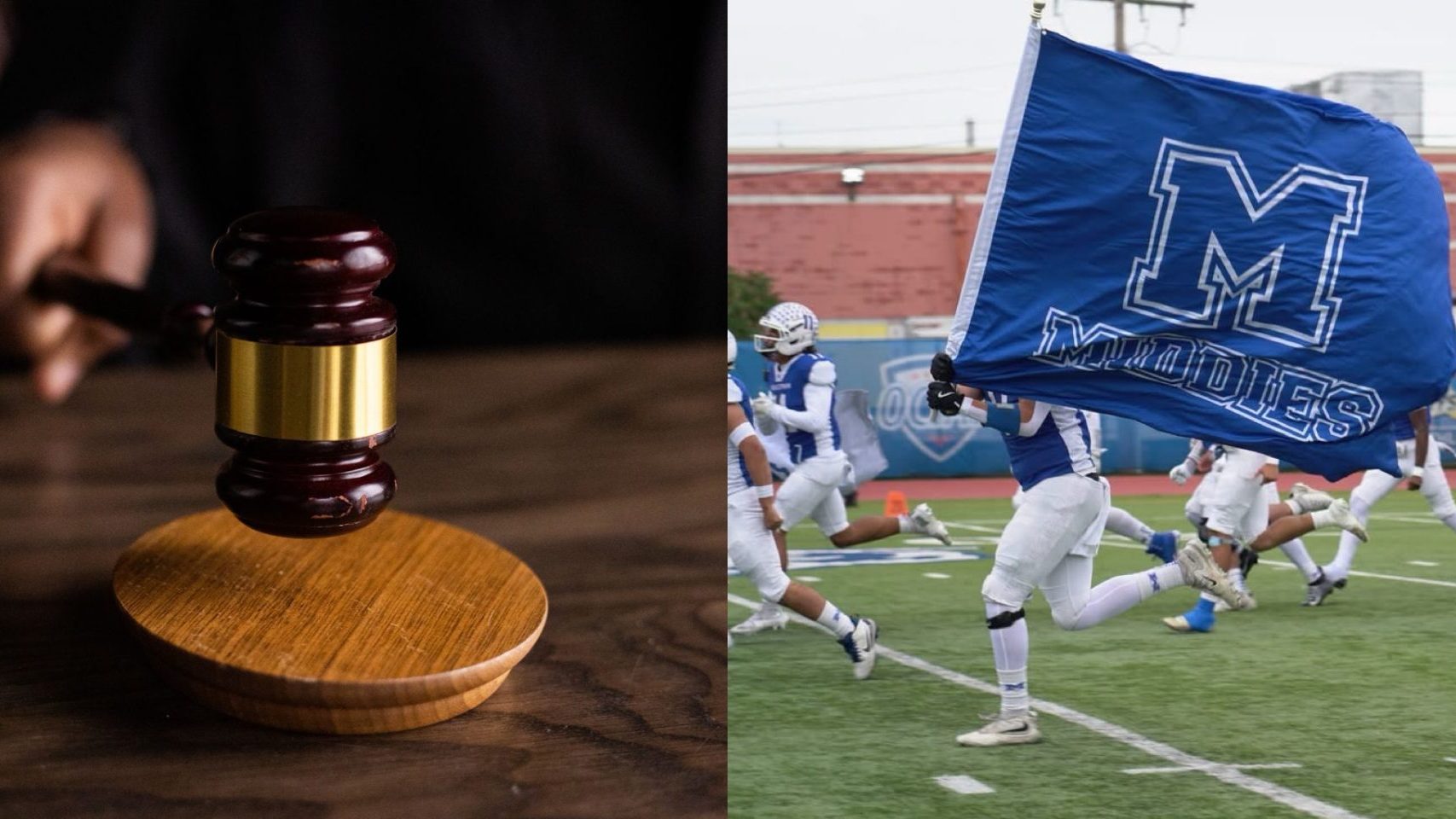
With an emergency hearing scheduled for Friday, Middletown’s challenge to Section IX and NYSPHSAA raises questions about eligibility enforcement, administrative oversight and the consequences imposed on student-athletes.
By KOT845 Media | November 12, 2026
Middletown withdraws – November 13, 2026, 3:54 p.m. EST
Isaac Cayetano reports Middletown withdrew its application and petition. At 4:55 p.m. EST, NYSCEF listed the case as Disposed. Notice #39 is CAPTCHA-blocked; written terms remain pending. This status is not a ruling on the merits.
Courtroom recess update – November 13, 2026, 2:58 p.m. EST
Reporting firsthand from recess, KOT845’s Isaac Cayetano said the parties largely repeated their written arguments. No ruling was reported in this dispatch.
Middletown acknowledged an unintentional rule violation but argued that enforcement should allow reconsideration of the circumstances and consequences for student-athletes.
Section IX and NYSPHSAA argued there was no legal basis to overturn the determination. They said reinstatement would harm Valley Central, which prepared for Newburgh but would lose its place, and Newburgh, which prepared for Valley Central rather than Middletown.
Earlier cases: NYSPHSAA cited Aquinas as supporting the forfeiture. Middletown cited Long Island cases; Newburgh’s counsel disputed the comparison, saying that litigation involved a trial. That procedural description is counsel’s argument, not an independently checked finding.
Source/disclosure: Cayetano is KOT845’s founder and a Middletown assistant coach. These are paraphrases from his courtroom account, not transcript quotations or judicial findings. No reinstatement or championship change is established by this report.
Hearing appearance clarified by court; Valley Central seeks acceptance of late evidence — November 13, 2026, 10:41 a.m. EST
Newly obtained, court-stamped Documents #36–38 clarify Friday’s 2 p.m. Article 78 hearing. In NYSCEF case EF012752-2026, Documents #36 and #37, both filed at 10:11 a.m. Friday, contain written directions from Justice Verris B. Shako’s chambers responding to requests for virtual attendance. The directions are not a ruling on Middletown’s eligibility or request for a temporary restraining order.
Section IX: The court’s notation on Document #36 allows Executive Director Gregory Ransom to appear virtually, but requires attorney Stephanie M. Roebuck to be physically present in the courtroom. In the underlying letter, Roebuck asks to conduct the entire appearance virtually because Ransom is traveling. The court’s response does not approve that broader request.
Middletown: The court’s notation on Document #37 permits lead attorney Kate I. Reid to observe virtually, but requires an attorney for Middletown to attend in person and make all relevant arguments and representations. The filing does not identify which attorney will make those in-person arguments. No new hearing time or postponement is established by either response.
Late-filed Valley Central evidence: In Document #38, filed at 10:14 a.m., Valley Central attorney Daniel Petigrow asks the judge to consider Theresa Uhelsky’s affidavit (Document #27) and supporting Exhibits A–H (Documents #28–35), despite their filing shortly after the court’s 9:30 a.m. opposition deadline. Petigrow attributes the delay to difficulties caused by a Microsoft service outage and says that Middletown’s attorney, Reid, has no objection to his request. Those are Petigrow’s representations in a letter, not a judicial finding; the letter does not itself establish that the late submissions have been accepted. KOT845 has independently reviewed Exhibits A–H, as detailed below, but has not received the underlying affidavit in Document #27 for full-text review.
Current posture: The publicly listed case remains active, with Document #38 the latest numbered entry at this check. No later signed order granting a TRO, reinstating Middletown, changing the 2 p.m. appearance, or resolving the merits was identified. The original signed Order to Show Cause (Document #13) schedules the hearing but did not grant reinstatement.
Eight court exhibits reviewed: Coates agreement, 2019 pledge and November 8 emails — November 13, 2026, 10:22 a.m. EST
KOT845 has now reviewed the eight court-stamped PDFs in NYSCEF Documents #28–35, Exhibits A–H, filed Friday at 9:45 a.m. by attorney Daniel Petigrow for Valley Central. The documents were supplied directly to KOT845 and match the titles and filing information in the official NYSCEF docket, index EF012752-2026. This review supersedes the earlier 9:55 a.m. access caveat concerning those eight exhibits. They are documents presented by a litigant, not findings by Justice Verris B. Shako. The separate affidavit in Document #27 has not been provided to KOT845 for this review.
David Coates’ proposed advisory role is documented, but execution remains pending. Exhibit E (Document #32) contains a June 2026 consulting agreement naming former athletic director David Coates. Its terms describe a “Consultant Coach” who would report to the superintendent and mentor the newly appointed athletic director and assistant director on operations, district protocols and compliance. It provides for up to 90 full workdays during the 2026–27 school year at $900 per full day. Crucially, the filed copy has blank signature lines and expressly requires execution and Board of Education ratification before taking effect. It therefore establishes the proposed scope and rates, not that the agreement was executed, any particular work was performed, or any payment was made. Nor does it check the previously reported specific conversation about adding the soccer player or show Coates was acting on Section IX’s behalf.
Leadership transitions and overlapping affiliations: Exhibit C (Document #30), Middletown’s July 2 personnel memorandum, lists June 30, 2026 as the last workday for Coates in his district director position and for Justin Sturge in his assistant athletic director position. Exhibit D (Document #31), Section IX’s 2026–27 directory, separately lists Coates on its Central Committee. Those records help establish the administrative context, but do not identify who gave the coaches the disputed eligibility advice or in which capacity any advice was delivered.
The three-game rule appeared in the athletic-director workshop materials. Exhibit B (Document #29) contains pages from NYSPHSAA’s 2026 Athletic Director’s Workshop, including a slide headed “26. Representation” that says football athletes must be eligible participants in a minimum of three contests. Critically, that slide does not expressly say the three-contest requirement governs postseason eligibility, identify sectional or state competition, or explain the forfeiture consequence. Those postseason details appear in the separate handbook excerpt (Exhibit A), not in the slide shown in Exhibit B. The excerpts also do not establish what presenters may have explained orally. The excerpt includes attendance-source review and registration slides, but not an individual attendance record for Sturge. NYSPHSAA’s earlier memorandum asserts that he attended; the provided slides independently establish the material presented, not his presence or what he later conveyed. Exhibit A (Document #28) reproduces the representation rule and its written waiver provisions. Although NYSPHSAA counsel argues that no retroactive waiver is available, the quoted extenuating-circumstances paragraph itself requires a written request by the Section Executive Director without separately spelling out a retroactivity deadline. That textual distinction does not establish that a late waiver was legally available.
A prior promise resurfaces from 2019. Exhibit F (Document #33) is a Middletown district acknowledgment of a forfeiture after using a 19-year-old fifth-year senior. The district said it would add eligibility-vetting checks and balances moving forward. The acknowledgment documents that pledge; it does not establish which safeguards were actually implemented or whether the 2026 mistake involved the same process.
The November 8 email trail identifies an early inquiry, not the original tipster. Exhibit H (Document #35) contains a Sunday, November 8, 1:34 p.m. message from Valley Central athletic director Theresa Uhelsky to Cornwall athletic director Jason Semo and Monroe-Woodbury’s Bryan Wilson, copying Evette Avila. Uhelsky wrote that an eligibility concern had been brought to her attention that day; she questioned why a Middletown soccer player who appeared in the November 6 semifinal and October 30 Kingston football film did not appear on an earlier Section IX football roster or on the roster Valley Central received for its October 9 meeting. Semo responded at 3:29 p.m. that he could contact Middletown about the student’s status, and Uhelsky later shared a soccer roster. The email chain does not identify who originally raised the concern, establish that Newburgh reported Middletown, or establish when Section IX first learned of the issue. Exhibit G (Document #34) includes a redacted football roster, limiting independent source review of player identities. KOT845 is preserving the student redactions.
Court status: At this review, the official docket also lists Documents #36–38 as court correspondence and a party letter, but their substantive contents have not been checked; they cannot be treated as an order or a hearing change. No new signed order reinstating Middletown or granting a temporary restraining order was identified in the listing. The previously signed Order to Show Cause set a 2 p.m. Friday appearance; its format remains unconfirmed. This evidence may inform the parties’ arguments, but the district’s eligibility dispute remains unresolved pending judicial action.
Docket update — November 13, 2026, 9:55 a.m. EST: Eight additional exhibits filed
New documentary filings are now listed ahead of Friday’s emergency hearing. The official Orange County NYSCEF docket for index EF012752-2026 now lists eight exhibits, Documents #28–35 (Exhibits A–H), filed November 13 under attorney Daniel Petigrow’s name, in addition to his previously docketed affidavit (#27) and Valley Central opposition affirmation (#26). The docket marks Exhibits G and H as redacted pursuant to 22 NYCRR §202.5(e).
Evidence limitation: The public docket displays “Document being processed” for Exhibits A–H, and direct attempts to open the available affidavit/document-viewer links encountered a CAPTCHA. KOT845 has not what the affidavit or exhibits contain and is not treating their filing as proof of any asserted fact. As of the 9:55 a.m. docket check, the case remains active and no subsequent court order granting a temporary restraining order or restoring Middletown to Saturday’s Class AA championship is listed. The publicly reported 2 p.m. Friday hearing has not been replaced by a newly official hearing-time or format notice. The preceding 9:41 a.m. docket snapshot, which identified #27 as the latest filing, is superseded by this update.
What the filings mean for Middletown — legal analysis, November 13, 2026, 9:41 a.m. EST
Analysis based on the parties’ filings and the publicly listed court record, not a prediction of Justice Verris B. Shako’s ruling.
Middletown is entering Friday’s emergency hearing with a difficult legal burden. The dispute has shifted beyond whether the soccer-player-turned-kicker intended to break a rule, whether he affected the semifinal’s final score, or whether the players deserve another game. The central question is whether Section IX and NYSPHSAA’s eligibility and forfeiture decisions can be overturned under the demanding standards for judicial review in an Article 78 proceeding.
Why the district faces an uphill battle
The underlying violation is largely undisputed. Middletown acknowledges that its kicker met the three-contest postseason representation requirement for only one regular-season football contest. The district’s case therefore cannot rest on proving that the three-contest standard was actually met; it must identify a legally sufficient defect in the way the rule or sanction was imposed.
The athletic associations say forfeiture is required, not optional. In NYSCEF Document #25, NYSPHSAA’s counsel argues that Rule 19 mandates forfeiture when an ineligible player participates, that the player’s limited role does not create a lesser penalty, and that the association lacks authority to grant a retroactive waiver after postseason participation. Those are arguments advanced by NYSPHSAA, not judicial findings.
Valley Central says it has a right to advance. Its opposition in Document #26 relies on Rule 19(b), which counsel says requires the opposing team to move forward when a postseason victory is forfeited. Reinstating Middletown would consequently affect Valley Central’s claimed place in the Class AA title game, not simply undo an administrative punishment. Newburgh has also filed opposition papers concerning its own championship preparations.
The workshop dispute complicates the claimed breakdown in guidance. NYSPHSAA’s memorandum asserts that Middletown’s athletic director attended a September session addressing the representation and penalty rules, while Valley Central’s filing points to the September 14 meeting. These assertions could become relevant to the question of what administrators knew or should have known. Attendance at a workshop, however, does not by itself establish what the head coach was actually told when the football staff sought eligibility guidance. KOT845’s separate, attributed reporting about a possible consultation with former athletic director David Coates remains an account from a source, not a court-established fact.
The standard of review is narrow. Attorneys opposing Middletown cite decisions limiting judicial intervention in school athletic association matters unless a determination is arbitrary, capricious, contrary to lawful procedure or an abuse of discretion. For emergency injunctive relief, Middletown must also persuade the court on the applicable requirements, including likelihood of success, irreparable harm and the balance of equities. A punishment can seem disproportionate and still survive judicial review if it rests on a valid, consistently applied rule.
What argument remains for Middletown?
The district’s strongest unresolved concerns involve the reported chain of administrative advice, the accuracy and completeness of the guidance given to coaches, procedural fairness, and the effect on student-athletes who relied on adults to establish eligibility. Those concerns are substantial to the people affected, particularly graduating seniors. But the court must find a legal basis to intervene; sympathy for the players or a showing of unintentional administrative error alone may not be enough to set aside the forfeiture.
What to watch at 2 p.m.: Whether Middletown can show a defect in the eligibility determination or the process used to reach it that warrants emergency relief, notwithstanding the acknowledged three-contest issue and the respondents’ arguments about Rule 19. An Order to Show Cause schedules a hearing; it does not itself reinstate Middletown or award a TRO. In a check of the official NYSCEF docket at approximately 9:41 a.m. EST, Document #27 remained the latest numbered filing and no later order granting reinstatement was listed. Document #27’s affidavit has been docketed, but its contents have not yet been independently reviewed. The hearing remains scheduled for Friday, November 13, at 2 p.m., with format unconfirmed.
Valley Central’s court opposition reviewed — November 13, 2026, 9:36 a.m. EST
Valley Central has formally opposed Middletown’s emergency request. In the four-page NYSCEF Document #26, filed at 9:19 a.m. November 13 and supplied in full to KOT845, attorney Daniel Petigrow, representing Valley Central School District, argues that the eligibility violation and Section IX’s resulting forfeiture were neither arbitrary nor capricious. He asks Justice Verris B. Shako to deny Middletown’s temporary restraining order request, which would put Middletown into Saturday’s Class AA championship against Newburgh in Valley Central’s place. This is Valley Central’s position in litigation, not a ruling or finding by the court.
The rule and waiver arguments: Petigrow cites NYSPHSAA Rule 19(b), which he says requires the opposing school to advance in place of an ineligible team after a postseason forfeit. He also argues that a representation-rule waiver is limited to documented medical grounds or qualifying extenuating circumstances and that Middletown has not presented evidence supporting either basis. The filing cites an affidavit attributed to Theresa Uhlesky and states that Section IX held an athletic-director eligibility meeting on September 14, 2026; the official Section IX website separately lists a mandated NYSPHSAA workshop on that date. Petigrow’s affirmation does not independently establish what eligibility advice Middletown’s head coach received from administrators.
Filing and championship caveats: Petigrow describes Saturday’s championship as taking place “tomorrow evening,” which differs from the noon NFHS Network listing noted below; this wording is not confirmation of a changed kickoff. The official docket also now lists Document #27, an affidavit filed by Daniel Petigrow, with a “document being processed” message; its substance has not been reviewed. KOT845’s earlier 9:27 a.m. note that Document #26 was CAPTCHA-blocked has been superseded by review of the supplied court-stamped PDF. No new order granting Middletown emergency relief or restoring its eligibility was listed at this check. The 2 p.m. Friday hearing remains the last appearance time, and the format is not confirmed.
New court-paper review — November 13, 2026, 9:27 a.m. EST: NYSPHSAA details its opposition
KOT845 has now reviewed the complete eight-page, court-stamped copy of NYSCEF Document #25, filed at 9:02 a.m. Friday. The filing, provided to KOT845 and independently matched to the official docket listing, is a memorandum by attorney Renee L. James on behalf of NYSPHSAA asking Justice Verris B. Shako to deny Middletown’s request for a temporary restraining order and preliminary injunction and dismiss its Article 78 petition. These are the association’s legal positions, not findings by the judge.
The substance of NYSPHSAA’s argument: James says the player was eligible for only one regular-season football contest, rather than the three required for postseason participation, Rule 19 requires forfeiture after an ineligible player participates, and neither the player’s limited involvement nor the game’s final score permits an alternative penalty. She argues that the limited extenuating-circumstances waiver requires a written request before sectional participation and cannot be issued retroactively. James also distinguishes the 2025 Strouse wrestling case, arguing it concerned a different rule and relief sought before an ineligible athlete competed.
New assertions requiring attribution: James states that Middletown’s athletic director attended a September mandatory workshop with slides addressing the representation standard and Rule 19 penalties; the memorandum itself does not include attendance records. She also alleges “upon information and belief” that coaches sought a better kicker for the postseason. The latter is counsel’s allegation in a legal brief, not independently established evidence of motive or a judicial finding.
Other docket developments: Document #24, filed at 8:40 a.m., is Section IX counsel Stephanie M. Roebuck’s notice of appearance. The docket now also lists Document #26, an affirmation filed November 13 by Daniel Petigrow. At the time of this 9:27 a.m. update, the filing’s contents were pending because the public NYSCEF viewer redirected to CAPTCHA. KOT845 subsequently obtained and reviewed the court-stamped filing; see the later document review above. The earlier 9:15 a.m. note that Document #25 had not yet been reviewed is superseded by this examination of the supplied PDF. No new judicial order reinstating Middletown or granting a TRO was listed at this review. The Friday appearance remains set for 2 p.m. with format unconfirmed; the Section IX Class AA final remains listed for noon Saturday, with Newburgh’s opponent shown as TBA.
Court and championship update — November 13, 2026, 9:15 a.m. EST
Two additional court filings are now listed. The official NYSCEF docket for case EF012752-2026 lists Document #24, a November 13 notice of appearance filed by attorney Stephanie Marie Roebuck, and Document #25, a November 13 memorandum of law in opposition filed by attorney Renee L. James. Both are marked processed. The substance of Document #25 has not been independently reviewed: the public NYSCEF document viewer directed KOT845 to a CAPTCHA source review page. We cannot characterize the new memorandum’s arguments without reviewing it. The filings are not a decision by Justice Verris B. Shako. No subsequent order reinstating Middletown or granting temporary relief was listed at this check; the emergency appearance remains scheduled for 2 p.m. Friday, with the exact appearance format unconfirmed.
Saturday’s Class AA kickoff listing has been clarified: The NFHS Network’s NYSPHSAA–Section IX football event listing now shows the November 14 Class AA final at noon EST (5 p.m. UTC) at Monroe-Woodbury High School, with Newburgh Free Academy vs. an opponent listed as TBA. This differs from the 6 p.m. kickoff stated in Middletown’s original court petition and some earlier reports. The broadcaster’s TBA designation does not resolve the pending eligibility dispute or confirm that Middletown has been reinstated.
New court filing — November 12, 2026, 8:09 p.m. EST: Newburgh opposes emergency relief
Newburgh has now formally responded. In NYSCEF Document #23, filed Thursday at 8:09 p.m., attorney David S. Shaw submitted an affirmation on behalf of the Enlarged City School District of Newburgh opposing Middletown’s request for a temporary restraining order. Shaw argues that NYSPHSAA Rule 26(a) requires a football athlete to have been eligible for three regular-season contests to participate in sectionals, while Middletown’s kicker was eligible for only one. He contends that Rule 19 consequently requires forfeiture.
Newburgh’s legal position: Shaw argues that Middletown has not shown arbitrary or capricious enforcement, irreparable harm or a likelihood of success in court. He cites the Aquinas, Gerard and Caso decisions in support of judicial deference to NYSPHSAA rules, and says Newburgh has been preparing to face Valley Central on November 14. The affirmation asks the court to reject the TRO request and dismiss the matter. These are Shaw’s statements and legal arguments, not findings or orders by Justice Verris B. Shako.
What this changes: Newburgh’s opposition is now in the court record. Document #23 does not grant or deny a TRO, reinstate Middletown or change the previously scheduled Friday, November 13, 2 p.m. court appearance. One wording discrepancy remains: Shaw calls Saturday’s contest a “sectional semi-final,” while the district identifies November 14 as the Class AA championship.
Earlier court update — November 12, 2026 (evening)
Section IX has now filed its own formal opposition to Middletown’s emergency request. In NYSCEF Document #20, attorney Stephanie M. Roebuck argues that the admitted postseason representation violation requires forfeiture under NYSPHSAA’s penalty rules, regardless of whether school administrators acted in good faith or whether the kicker affected the score. Section IX cites the 2014 Aquinas ruling and the consequences that a late change would create for Valley Central and Newburgh.
The Section IX filing also provides a new account of the November 8 timeline: Roebuck states that a Section IX football committee member asked Executive Director Gregory Ransom what penalty would apply if an ineligible player had participated in a postseason game, before Ransom received Middletown’s written report. That account does not identify the committee member or establish which school initially raised the concern.
Two newly filed letters address Friday’s appearance. Section IX’s counsel says Ransom is out of state and requests a virtual hearing; Middletown’s lead attorney Kate Reid also explains that she cannot travel in person for medical reasons. Section IX’s letter describes Ransom as the only person within Section IX directly involved in the contested matter. That assertion does not establish whether former Middletown athletic director David Coates was separately consulted in an informal mentoring capacity, as a source has reported to KOT845.
Hearing format remains unconfirmed. Judge Shako’s signed order schedules the parties for Friday, November 13 at 2 p.m., but no subsequent order changing that time or restoring Middletown’s eligibility was checked in the latest docket review. Read the official NYSCEF docket, particularly Documents #20–22.
MIDDLETOWN, N.Y. — The Enlarged City School District of Middletown will enter an Orange County courtroom Friday facing a difficult legal question: Can a football team be restored to postseason competition after its own administrators acknowledge that an ineligible player participated in a playoff game?
It is a question involving more than one player, one game or one missed requirement.
Middletown’s varsity football team completed a 9-0 regular season and defeated Valley Central 48-15 in the November 6 Section IX Class AA semifinal. That victory brought the program to 10-0 on the field, a mark the district says it had not achieved since 1961.
Two days later, the district reported an eligibility violation involving a kicker who joined the football program from boys soccer late in the season. Section IX declared the semifinal a forfeit, and NYSPHSAA upheld the determination.
The decision removed Middletown from Saturday’s championship against Newburgh and advanced Valley Central in its place.
Now, with 49 football players affected and seniors facing the potential end of their high school careers, the district is asking the courts to intervene.
The case also brings renewed attention to the adults responsible for athletic eligibility, the officials available to advise them and an earlier Middletown controversy that resulted in multiple forfeitures.
A Friday hearing, but no reinstatement yet
The district filed its Article 78 proceeding on November 11 in Orange County Supreme Court.
The case, EF012752-2026, has been assigned to Justice Verris B. Shako.
On November 12, Judge Shako signed an Order to Show Cause scheduling a court appearance for Friday, November 13, at 2 p.m.
The signed order is important for what it includes and what it does not.
Judge Shako authorized the emergency proceeding and directed the parties to appear. However, she crossed out proposed provisions that would have immediately granted Middletown a temporary restraining order and annulled the disqualification.
As of the latest reviewed docket, Middletown has not received a court order restoring its championship eligibility.
The court will consider arguments from the district and the organizations responsible for the eligibility determination. Newburgh and Valley Central have also been named as respondents because their postseason interests could be affected.
Update, November 12: The case docket now includes opposition papers submitted by Section IX counsel Andrew Tureaud, following opposition from NYSPHSAA. Correspondence regarding requests for virtual appearances has also been filed. The contents of the newest filings have not all been independently reviewed, and no additional court order reinstating Middletown was confirmed at this update.
How a late-season addition became a postseason violation
According to Middletown’s petition, a varsity soccer player joined its football program on October 13 to serve as a kickoff specialist.
The student remained involved in soccer while completing football practices.
The soccer season ended October 28. The district says the athlete completed ten football practices on or about October 29 and was eligible to participate in the October 30 regular-season football game against Kingston.
He subsequently participated in the November 6 playoff semifinal against Valley Central.
There were two separate eligibility requirements at issue.
The first required the athlete to complete ten qualifying football practices before game participation.
The second, NYSPHSAA’s postseason representation standard, required him to have been eligible for at least three regular-season football contests before participating in sectional competition.
Middletown acknowledges that the kicker satisfied the latter requirement for only one game.
The district’s petition describes his semifinal involvement as eight kickoffs.
NYSPHSAA’s position is that the representation standard does not change according to an athlete’s position or the influence the athlete had on the final score.
That distinction sits at the center of the legal disagreement.
Beyond the superintendent: Who was responsible for the original eligibility guidance?
Superintendent Amy Creeden has become the public face of Middletown’s response, signing the district’s legal source review and issuing statements to families and the community.
But a superintendent’s responsibility for responding to a controversy is distinct from firsthand responsibility for the eligibility guidance that preceded it.
Three individuals have particularly relevant roles in understanding what occurred: head football coach Tim Strenfel, athletic director Justin Sturge and former athletic director David Coates.
Tim Strenfel has led Middletown’s football program since 2017. As head coach, his role in adding the soccer player and communicating with athletic administrators is relevant to reconstructing the timeline.
Justin Sturge is Middletown’s current Director of Health and Athletics. He is in his first year leading the athletic department, after previously serving as an assistant athletic director.
David Coates is Middletown’s former athletic director, but his experience extends beyond the district.
Coates is listed by NYSPHSAA as Section IX’s male athletic representative on the state association’s Central Committee, with a term running through 2029.
He was also identified as Section IX’s football chair in its 2025–26 directory and as a Class AA committee representative in Section IX football materials.
Those are substantial administrative credentials. They establish that Coates has held responsibilities involving Section IX and state interscholastic athletics.
A reported chain of guidance built around an established working relationship
According to a source familiar with discussions within Middletown’s athletic department, Strenfel approached Sturge during Week 7 about adding a soccer player to the football roster. Sturge subsequently consulted Coates, who reportedly advised him about the ten-practice requirement. That information was then communicated back through the athletic department to the head coach.
But the reported consultation carries additional context.
The source describes Sturge and Coates as having an established mentoring relationship, with the former athletic director continuing to provide guidance as Sturge transitioned into his new leadership position.
According to that account, consulting Coates was a routine part of Sturge’s professional development. Questions involving scheduling, athletic administration, eligibility and other daily responsibilities were the kinds of matters on which the newer athletic director could turn to his experienced predecessor.
In that context, the reported inquiry about adding a soccer player was not necessarily an extraordinary request. It was the type of question a first-year athletic director might raise during an ordinary workday while learning the responsibilities of the position.
That relationship is important because it may explain why Sturge would seek Coates’s guidance and why the coaching staff would rely on information communicated by its athletic director.
Coates was not simply a former school employee offering an informal opinion. His documented background includes leadership positions within Section IX football and representation at the state association level.
For an athletic director assuming a new role, advice from someone with that experience could reasonably carry weight.
Likewise, a head coach consulting his athletic director about a roster addition is following an established administrative reporting relationship.
The relevant issue becomes what information was requested, what guidance was provided and whether that guidance was understood as permission to proceed.
KOT845 has not independently checked the precise conversations or obtained written communications documenting the reported advice. The district’s publicly reviewed legal petition acknowledges an adult administrative oversight but does not identify the individuals involved in each consultation.
It remains unknown whether Coates gave a general explanation of the ten-practice rule, specifically approved the player’s participation, or was asked about postseason eligibility at all.
Those differences are legally significant.
Was Coates advising as a mentor or acting in an official representative capacity?
One of the most important unanswered questions concerns the capacity in which Coates reportedly provided guidance.
When Sturge contacted Coates, was he seeking advice from Middletown’s former athletic director and an experienced mentor, or was he asking someone serving in an official Section IX or NYSPHSAA representative role to interpret an eligibility requirement?
The distinction matters.
Coates’s experience and current committee representation are documented. But holding a representative position does not necessarily mean an individual has authority to issue binding eligibility determinations or approve an exception to NYSPHSAA rules.
If Coates was offering informal professional advice, the question becomes whether Sturge was also responsible for obtaining formal clarification from the appropriate athletic authorities before approving postseason participation.
If Coates was consulted specifically in an official representative capacity, another question emerges: What authority was being exercised, what information was supplied, and what exactly was communicated back to Middletown?
There is also a difference between a player being cleared to join a roster, completing practices, becoming eligible for a regular-season contest, and becoming eligible for postseason competition.
Those are not interchangeable approvals.
What Sturge understood and subsequently communicated to Strenfel may therefore be as important to reconstructing the administrative mistake as the initial advice itself.
But even if the consultation occurred exactly as described, it would not automatically absolve the district of its obligation to follow eligibility rules.
Nor would it establish that Coates personally caused the violation.
The responsibility to check eligibility belongs to the athletic program and its administrators. The question is how that responsibility was exercised, and where the process broke down.
Questions that still need answers
The circumstances surrounding the kicker’s addition leave several important questions unresolved:
- Who initially identified the soccer player as a potential kicker?
- Who proposed adding him to Middletown’s football roster?
- Who formally approved the roster addition?
- What did Strenfel specifically ask Sturge about the player’s eligibility?
- What did Sturge specifically ask Coates?
- Was Coates informed that the player was being added during Week 7, with the postseason approaching?
- Was Coates advising as a mentor, former athletic director, or in an official Section IX or NYSPHSAA capacity?
- If that guidance was informal, did Sturge independently seek a formal eligibility determination from an authorized official?
- Did the conversations address regular-season eligibility, postseason eligibility, or both?
- Did Coates provide an explicit green light, or explain only the ten-practice requirement?
- Who ultimately communicated approval to the head coach?
- Was that approval documented?
- Who was responsible for reviewing the player’s postseason eligibility before the November 6 semifinal?
- Why was the separate three-contest representation requirement not identified during that review?
These questions do not presume wrongdoing by any individual. They concern the sequence of decisions and communications that preceded an acknowledged administrative error.
If the reported consultation sequence can be substantiated, it may be an important part of understanding the case. Whether the court considers that evidence, and what legal weight it carries, will depend on the record presented by the parties.
Regardless of Friday’s ruling, the district’s internal eligibility process warrants careful examination.
The distinction between an administrative mistake and the students who competed
The district has characterized the violation as an unintentional administrative oversight.
The responsibility for reviewing eligibility, interpreting regulations and granting participation approval rests with adults overseeing the athletic program.
The student-athletes, meanwhile, were participating in the program under the direction of their coaches and school officials.
The district has not alleged that the other players were responsible for the eligibility error.
Whether the mistake arose from incomplete advice, misunderstood guidance, or a missed source review step, those explanations concern adult decision-making—not misconduct by the students whose season is now at risk.
That distinction does not determine the legal outcome. NYSPHSAA’s position is that postseason eligibility penalties apply even when a violation is unintentional.
But it does explain why the incident has prompted such intense scrutiny of the district’s administrative procedures.
It also raises a broader question that will remain relevant regardless of the court’s ruling: How can schools ensure that an eligibility error by adults does not become a preventable crisis for the student-athletes under their supervision?
NYSPHSAA says administrators had already been trained
Middletown’s case now faces another significant challenge.
In a six-page affirmation filed November 12, NYSPHSAA Executive Director Dr. Robert Zayas argues that the association’s eligibility requirements were clear and that the school was responsible for applying them.
Zayas also raises questions about the student’s practice qualifications before October 23, although the three-game representation requirement remains the central postseason issue.
One of his most consequential assertions concerns athletic administrator training.
Zayas states that NYSPHSAA conducts mandatory workshops for athletic directors each year and that a Middletown athletic director attended a September 14, 2026 session.
The publicly available workshop presentation addresses the ten-practice requirement for football and separately identifies Eligibility Standard 26 concerning representation.
The presentation does not publicly identify individual attendees or establish exactly how the football representation requirement was explained verbally.
An additional historical record raises questions about the extent of the district’s prior exposure to the terminology.
The January 13, 2026 OCIAA Athletic Directors Workshop minutes identify Sturge as a guest and document Coates’s participation in meeting business. The minutes also state that Christopher Mayo and Gregory Ransom explained the difference between representation and participation.
That record does not establish precisely what either administrator heard or understood, nor does it establish that the discussion addressed the specific football situation Middletown would encounter months later.
Nevertheless, it documents that the distinction was an agenda topic at an official meeting where both men were present.
Combined with Zayas’s assertion about the September workshop, it raises a question about how eligibility information was communicated and retained within the athletic department.
Zayas also states that concerns were brought to Section IX by other schools before Middletown submitted its formal self-report.
Middletown’s petition confirms that the district reported the violation on November 8, at approximately 5:53 p.m.
The two accounts are not necessarily inconsistent. A district can submit a formal self-report after another school or official initially identifies a possible violation.
The 2014 Aquinas ruling: A precedent Middletown cannot ignore
The strongest legal obstacle identified in NYSPHSAA’s opposition is a 2014 decision involving the Aquinas Institute of Rochester.
The case, Aquinas Institute of Rochester v. Cerone, involved a quarterback, Jake Zembiec, and the same general requirement of eligibility for three regular-season football contests before sectional competition.
Aquinas challenged a postseason forfeiture and sought relief through an Article 78 proceeding.
On October 31, 2014, Monroe County Supreme Court Justice J. Scott Odorisi upheld the determination.
The court found that the athletic authorities had a rational basis for enforcing their rules.
The decision also addressed Aquinas’s argument that its athletic director had relied on advice from a sectional football official.
The court concluded that the official had not received a complete understanding of the relevant circumstances and that the conversation did not relieve the school of its independent responsibility to comply with the eligibility rules.
That reasoning is particularly relevant to Middletown if the current district attempts to establish that its administrators relied on guidance from another official.
The cases are not identical.
Aquinas involved a quarterback whose availability was strategically significant to the team’s offense. Middletown’s contested player was a kickoff specialist reportedly used on eight plays.
The Aquinas dispute also involved medical clearance and waiver considerations that differ from Middletown’s late-season dual-sport situation.
Those distinctions may be relevant to a court’s assessment of the circumstances and requested relief.
But they do not automatically create a legal exception. The postseason representation rule does not distinguish between a quarterback and a kicker.
The question is whether those factual differences provide a legally sufficient reason to distinguish Middletown’s case from the 2014 ruling.
Twelve years later, a broader policy question remains
The Aquinas ruling was issued twelve years before Middletown’s current dispute.
It demonstrated that a postseason representation violation could result in forfeiture even when school administrators raised questions about prior guidance.
The continued existence of disputes involving eligibility calculations and adult administrative decisions raises a broader policy question:
Have the state’s procedures for educating administrators, documenting eligibility decisions and preventing avoidable postseason violations been sufficient?
The existence of the 2014 decision does not prove NYSPHSAA failed to improve its procedures afterward. The association maintains that it provides annual training and applies a uniform rule approved by member schools.
Nor does a court have authority to disregard a valid regulation simply because its effects are severe.
Revisions to athletic eligibility rules generally must proceed through the association’s established governance process.
Nevertheless, the consequences of the Aquinas ruling, and the current consequences for Middletown, provide a basis for examining whether existing safeguards are effective and whether member schools should reconsider aspects of the policy in the future.
That debate is separate from what Justice Shako must decide under the rules currently in force.
Middletown has faced an eligibility controversy before
The current dispute also carries significance within Middletown’s own football history.
In 2019, the program forfeited its first four games because of an ineligible player, according to Section Nine Football’s archived team records.
Those were regular-season forfeitures.
Middletown’s postseason qualification opportunities were affected by the resulting standings, but the earlier violation did not have the same immediate tournament consequence as the 2026 semifinal forfeiture.
The difference is significant.
The current NYSPHSAA postseason penalty provision directs that a team using an ineligible athlete in a tournament contest forfeit that game, be removed from the tournament and have its last opponent advance.
The 2019 and 2026 violations involved different eligibility circumstances. The public record does not establish that the same individuals made the operative mistakes in both instances.
But the recurrence raises a legitimate institutional question:
After the 2019 forfeitures, what changes were made to Middletown’s eligibility source review procedures, and were those safeguards sufficient in 2026?
This is the second forfeiture controversy involving the program during Strenfel’s head-coaching tenure.
It does not establish that the coach personally caused either violation. It does establish a history that warrants scrutiny of the athletic department’s compliance systems.
NYSPHSAA argues the penalty cannot be changed after the fact
Middletown’s legal petition emphasizes that the team and its student-athletes did not intentionally break the rules.
It argues that the kicker’s limited role did not undermine competitive fairness and that the forfeiture places the heaviest consequences on students who had no responsibility for interpreting eligibility regulations.
The district proposed alternatives, including excluding the kicker from further postseason participation, additional training, financial responsibility and enhanced eligibility review procedures.
NYSPHSAA’s opposition takes a different position.
Zayas argues that the penalty for an ineligible player’s postseason participation is mandatory.
He also contends that the handbook does not authorize a retroactive waiver after the athlete has already competed.
Importantly, the filings reviewed by KOT845 do not accuse Middletown of deliberately cheating. Middletown describes the violation as an unintentional administrative error. Section IX and NYSPHSAA do not need to establish an intent to deceive under the penalty provisions they cite; their position is that an ineligible player’s postseason participation triggers forfeiture even if the mistake was made in good faith.
That is a critical distinction in this case: the dispute is not primarily over whether the players or administrators intended to gain an unfair advantage, but whether an acknowledged eligibility mistake permits any exception to a prescribed postseason penalty. Both athletic organizations argue that the forfeiture cannot be retroactively replaced with a different sanction under the current rules. That is their legal position—not a ruling the court has yet made.
According to his affirmation, even a timely waiver request under these circumstances would not necessarily have qualified for approval.
NYSPHSAA further argues that the postseason requirement protects competitive equity by ensuring students have a qualifying connection to a sport’s regular season before entering championship competition.
The association says that making the violation’s consequences depend on whether the student materially affected the score would create a difficult and inconsistent standard.
Zayas also raises the impact on other schools, including Newburgh’s preparation and the requirement for rest between contests.
Those concerns must be considered alongside Middletown’s position, particularly because Valley Central and Newburgh have interests directly affected by any change to the scheduled championship.
Section IX’s response: a mandatory penalty and consequences for other schools
Section IX’s separate, seven-page opposition filed on November 12 makes clear that the organization is not disputing Middletown’s account of an adult administrative error for purposes of its legal argument. Instead, Section IX says the reason for the mistake does not change the specified penalty once an ineligible athlete participates in a postseason contest.
Section IX attorney Stephanie M. Roebuck points to NYSPHSAA’s representation standard and postseason penalty provisions, arguing that the court cannot treat a good-faith mistake as an exception that the handbook does not provide. She cites the 2014 Aquinas Institute ruling as a direct example of a court finding a rational basis for enforcing the representation requirement.
Section IX also disputes Middletown’s request for emergency relief on grounds that extend beyond the kicker. It argues Valley Central was preparing to play the final after advancing under the forfeiture decision, while Newburgh prepared for Valley Central as its opponent. Roebuck warns that changing the matchup immediately before the final, and potentially resolving the case only after a later tournament round, could prejudice other teams.
On the question of harm, Section IX argues that the lost opportunity to play does not necessarily establish the legal threshold for an injunction. That is a legal argument in the respondent’s filing, not a finding by Judge Shako about the players or their experiences.
Section IX’s affirmation additionally references a mandatory athletic directors’ workshop addressing representation rules. The district’s source-reported consultations among Strenfel, Sturge and Coates still have not been established through the individual participants’ sworn accounts. Even if those conversations are confirmed, the court must separately determine whether they affect the legality of the forfeiture.
What makes Middletown’s case difficult — and what could support it?
The district faces a substantial legal challenge.
It has acknowledged the underlying representation violation, NYSPHSAA has identified a mandatory forfeiture provision, and the Aquinas decision provides an example of judicial deference to the association’s enforcement of a similar football rule.
Those are significant obstacles.
Middletown’s stronger arguments concern the effect of an acknowledged adult error on students, the claimed absence of an unfair competitive advantage, the permanent loss of a championship opportunity and whether the association handled its waiver request lawfully.
The reported consultation between Sturge and Coates could help explain the administrative circumstances if substantiated. It would not, by itself, establish eligibility or invalidate the forfeiture.
For the seniors involved, postponing a decision until after the championship could make meaningful relief impossible.
That urgency is relevant to the emergency application.
Yet the judge’s responsibility is not simply to select the outcome that seems most sympathetic.
Under Article 78, the court must determine whether the challenged administrative action had a rational basis, complied with the governing law and procedures, and remained within the authority of the organizations making the decision.
Middletown must establish a legal basis for judicial intervention despite the eligibility violation.
NYSPHSAA must defend the legality of its interpretation and enforcement of the rule.
Who will explain the original approval at Friday’s hearing?
Middletown’s court petition is checked by Superintendent Amy Creeden, who has led the district’s public response and represents its institutional position. The petition does not establish that she personally participated in the October discussions about adding the kicker.
Those conversations reportedly involved people closer to the original decision: head football coach Tim Strenfel, athletic director Justin Sturge and former athletic director David Coates, a longtime Section IX football official who also holds a NYSPHSAA Central Committee representative position.
According to a source familiar with the athletic department’s discussions, Strenfel consulted Sturge, who sought guidance from Coates before information about the ten-practice requirement was relayed back to the coaching staff. That account has not been independently corroborated through the participants’ communications or sworn testimony.
Will Strenfel, Sturge or Coates attend Friday’s appearance, provide sworn statements, or otherwise be available to explain what was asked and what was approved? The court records reviewed by KOT845 do not answer those questions. None of the three is named individually as a party, and the signed Order to Show Cause directs counsel and parties to appear; it does not specifically command these individuals to testify.
Their accounts could clarify whether the original question concerned regular-season practice eligibility or postseason representation, whether a formal clearance was sought, and whether Coates was giving informal advice as a mentor or speaking in an official representative capacity.
The judge may decide the immediate emergency application on legal submissions and counsel’s arguments without taking live testimony. The court is not necessarily conducting a complete investigation of individual responsibility at this appearance. But for the public, a full accounting of the district’s administrative decision requires an accurate record of the conversations that preceded it.
Regardless of how those conversations are eventually documented, the district has characterized the violation as an adult administrative mistake—not wrongdoing by the student-athletes who followed their team’s instructions.
Friday’s emergency appearance: What the public should know
Justice Shako’s signed Order to Show Cause schedules the parties to appear Friday, November 13, at 2 p.m.
The court set a 9:30 a.m. deadline for opposition submissions.
The proceeding is assigned to Orange County Supreme Court at:
285 Main Street, Goshen, NY 10924
Judge Shako’s published courtroom assignment is Courtroom 14.
However, the court has since received correspondence concerning a request for virtual participation.
In a November 12 notice, chambers requested further explanation concerning why other parties could not attend in person. An additional court notice has been entered on the docket, but its terms had not been independently checked at the time of this report.
Accordingly, the exact appearance format and courtroom arrangements should be confirmed before anyone travels.
Supreme Court proceedings are generally open to public observation, subject to applicable restrictions, courtroom capacity and court directions.
Members of the public seeking attendance information may contact Judge Shako’s part clerk, Barbara Ulbrich, at 845-476-3482.
The public should not contact the judge privately to advocate for an outcome in a pending proceeding. Substantive case materials should be submitted through the legally appropriate process.
The 2 p.m. appearance creates an opportunity for emergency relief, but does not guarantee that a final decision will be announced at that time.
A decision for the court, and questions that will remain afterward
The immediate dispute is whether Middletown can participate in Saturday’s Section IX Class AA championship.
The broader questions will remain regardless of Friday’s ruling.
Why was the eligibility requirement overlooked? What guidance was provided before the kicker’s addition? In what capacity did experienced officials reportedly provide advice? Was that advice independently checked? What did the January and September training sessions establish? And how can districts prevent student-athletes from facing the consequences of administrative failures in future seasons?
Middletown acknowledges that a rule was violated.
NYSPHSAA maintains that enforcing that rule consistently is necessary to protect fairness across member schools.
Both considerations are central to the dispute now before Justice Shako.
The decision may determine whether Middletown’s 2026 football season continues.
The responsibility to account for how the mistake occurred—and to prevent a similar situation from happening again—will extend well beyond the courtroom.
Court information: Enlarged City School District of Middletown v. Section IX Athletics, Inc., et al., Orange County Supreme Court, Index No. EF012752-2026.
Primary sources and additional reading:
- Official NYSCEF court docket
- Middletown’s published Article 78 petition
- 2014 Aquinas Institute of Rochester decision
- NYSPHSAA Central and Executive Committee directory
- Section IX 2019 team records
- September 14 NYSPHSAA Athletic Directors Workshop presentation
- January 13, 2026 OCIAA workshop minutes
- Justice Shako’s official courtroom rules
November 12 reporting. November 13 update above: petition withdrawn, case listed as disposed.
Editorial disclosure: KOT845’s founder also serves on Middletown’s football coaching staff. Source-attributed accounts of internal discussions are not presented as judicial findings.

Join the Conversation
Keep it respectful and focused on the story. First-time comments may be held for moderation.